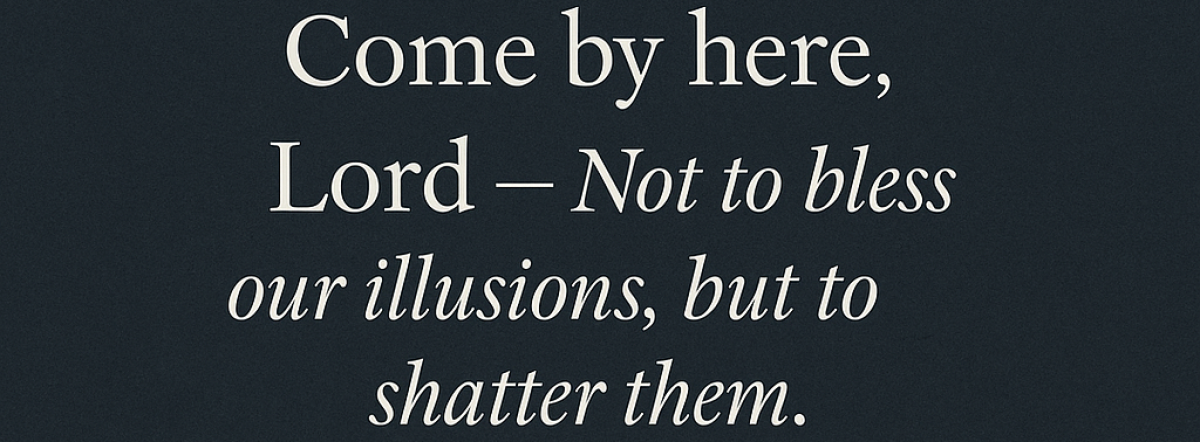
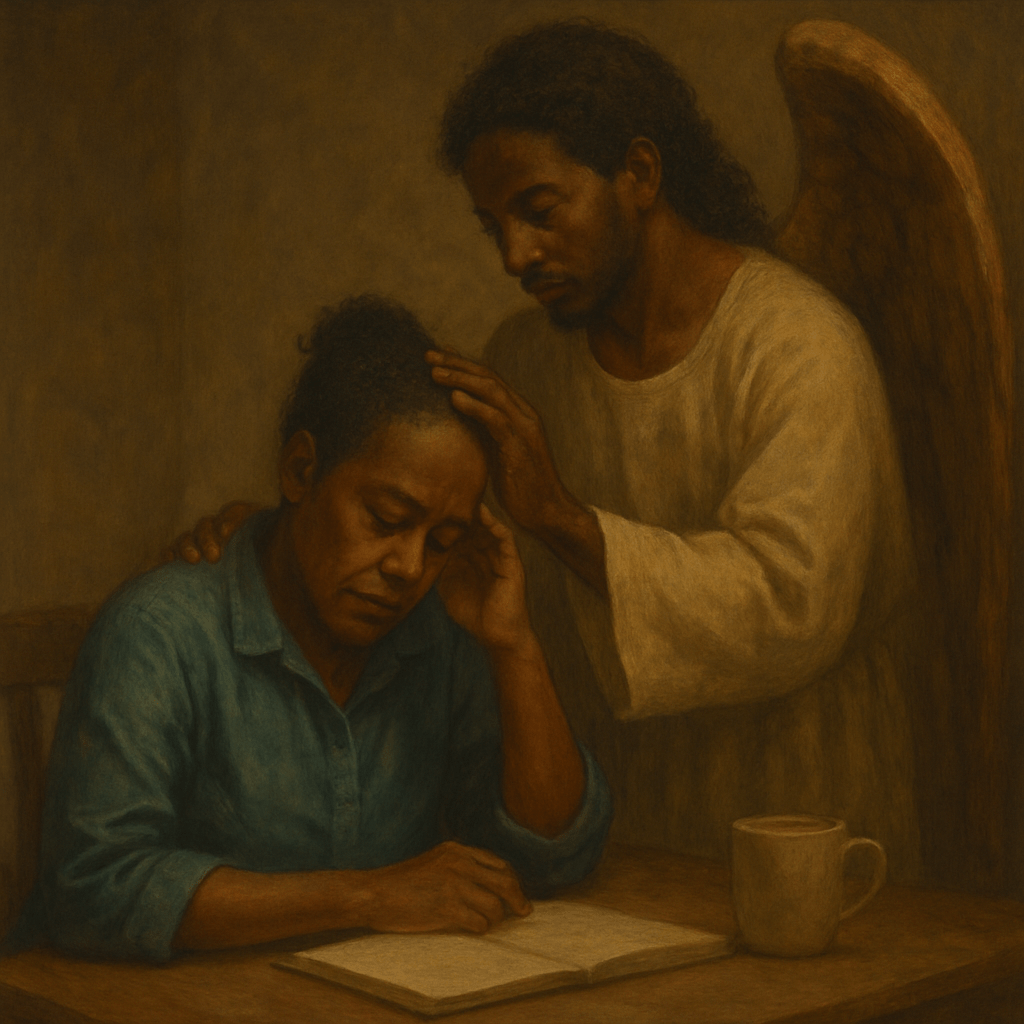
Lord, Is It Me?

There are moments in ministry that no seminary, no training, and no mentor could ever prepare you for. Moments where your deepest wrestlings are not with the congregation, the budget, or the community—but with yourself.

I’ve been in ministry for 27 years. In that time, I’ve learned how to navigate pain, cast vision, confront broken systems, and love deeply. I’ve stood when I didn’t think I could. I’ve preached when my spirit was empty. I’ve prayed when the words didn’t come easy.

But this season? This one is different.

This one is forcing me to ask a dangerous, sacred question:
“Lord, is it me?”

Not out of guilt.
Not out of failure.
But out of faith.

“But when evening came, he was reclining at the table with the Twelve. And while they were eating, he said, ‘Truly I tell you, one of you will betray me.’ They were very sad and began to say to him one after the other, ‘Surely you don’t mean me, Lord?’”
—Matthew 26:20–22 (NIV)

That moment around the table with Jesus resonates more now than ever. The disciples didn’t posture or pretend. They paused and examined themselves. And I find myself there too. Not because I’m betraying Christ. But because I love Him enough to wonder if, somehow, I’m getting in the way of what He wants to do through me.

I look around and see churches swelling in size, ministries going viral, and platforms growing with every click. But too often, what lies beneath that growth is theology that entertains instead of transforms, that appeases instead of convicts.

And here I am—trying to be faithful.
Preaching what I believe God has assigned to my heart.
Teaching what has been revealed through prayer, study, and sacred discernment.
Serving the community and building the Kingdom the best I know how.

Yet, growth feels slow. Sometimes stagnant.
And in moments of vulnerability, I wonder if the common denominator… is me.

What if I’m the bottleneck?
What if what I’m offering is no longer suited for a traditional church setting?
What if I’ve missed the mark?

And still—deep within—I believe I’m doing what God has called me to do.

But belief doesn’t always silence the burden.
Faith doesn’t always make the fog disappear.

So let me be honest. Let me be human.
I don’t need answers today. But I do need space.
And if you’re reading this—maybe you do too.

If you’ve ever found yourself questioning your impact,
If you’ve ever measured faithfulness by visible fruit and came up short,
If you’ve ever wondered whether your obedience really matters,
Then… come sit with me in this space.

“Let us examine our ways and test them, and let us return to the Lord.”
—Lamentations 3:40

“Search me, O God, and know my heart! Try me and know my thoughts! And see if there be any grievous way in me, and lead me in the way everlasting.”
—Psalm 139:23–24 (ESV)

I don’t want what people call success.
I don’t want vanity metrics.
I don’t want smoke and mirrors.

I just want to be faithful.
To give God my best.
To fulfill the totality of what I was created to do.

And maybe—just maybe—faithfulness means going back to the drawing board.
Not because I’ve failed.
But because I’m still being formed.

There’s no shame in reevaluation.
There’s no guilt in asking hard questions.
There’s only grace—grace to grow, to stretch, to evolve.

I don’t have all the answers.
But I still have the hunger to hear one thing from my Savior:

“Well done, good and faithful servant… Enter into the joy of your Lord.”
—Matthew 25:23 (NKJV)

Until then, I’ll keep showing up—
Searching.
Serving.
And staying close to the One who called me in the first place.


A Prayer for the One Who’s Wrestling

God of the table and the wilderness,
You who called us before we called You—
We are here with questions,
not because we doubt Your power,
but because we desire Your presence in the places we feel most unsure.

If we are the problem, reveal it.
If we are the planting, root us.
If we are the pruning, keep us.
If we are the remnant, strengthen us.

Speak to the quiet parts of our hearts.
Let our mission be Your mission.
And let us be faithful—not to outcomes, but to obedience.

May our “Well done” come not from the crowd,
but from Christ.

Amen.

Bleeding While Leading: The Unspoken Cost of Caring

Generated image

I hate what happens when you genuinely care for people.

Because when you care, you give. You pray, labor, sacrifice, and remain present even when your body says rest and your heart says retreat. But when you care, you open yourself to the inevitable: the heartbreak. The disappointment. The silence after the investment. The betrayal after the trust.

And deep down, you know it’s coming. You can sense it before it arrives. You try to brace for it. You even entertain the idea of becoming calloused enough to not feel it so deeply. But no matter how much you prepare, pain still finds its way in. That’s the strange paradox of pastoring: you are asked to be fully present, wholly available, spiritually discerning, and emotionally intelligent—while also guarding your heart from being shattered repeatedly.

I’ve often heard, “Don’t take it personally,” when people walk away from the congregation, speak poorly of a ministry effort, or misrepresent what pastoral leadership really entails. And while the advice is often well-meaning, I struggle with it. Because I am a person. I do take it personally. My humanity is not a separate compartment from my calling—it’s intertwined with it.

Someone once told me, “You’ll have to learn how to lead while bleeding.” I’ve never forgotten those words. But as I’ve grown, I’ve also come to believe this: ministry doesn’t require sepsis to prove your dedication. You don’t have to die inside to stay faithful to your post. You don’t need to sacrifice your wholeness to prove your worth.

Instead, I’ve found something more meaningful: the sacred space of holding humanity and holiness together. The pastoral role is not to bleed out, but to feel deeply without infecting others. I don’t want to become numb. I want to be authentic. And authenticity means admitting: some days, this is hard. Not because I don’t love God. But because I love people—and loving people means risking heartbreak.

Is there an answer to how we navigate the personal from the prophetic? Can a pastor bring their full self—heart, mind, spirit, and scars—into the pulpit and still walk in power?

I believe we can. I believe authenticity is not only possible—it’s necessary.

But we have to take our cues from Jesus. In the Garden of Gethsemane, Jesus was fully divine, but also fully human. He didn’t pretend that the weight of the cross was light. He questioned. He lamented. He asked for another way. And then… He accepted the assignment.

That garden moment gives me permission to be honest with God. To weep. To feel. To ask. To hope. And still to lead.

Maybe we’re all in some kind of garden right now—struggling with obedience and honesty at the same time. Hoping to arrive at peace while still reeling from pain. Maybe that’s what Paul meant when he said strength is made perfect in weakness. Maybe the hard places don’t disqualify us—they disciple us.

I don’t have all the answers. I just know some days, I wish it didn’t hurt so much.

And maybe—just maybe—that’s the step of faith.


Prayer of Reflection:

God of Gethsemane and Calvary,
Teach us to lead with tender strength.
Give us space to feel,
Permission to question,
And courage to continue.

Guard our hearts,
But don’t let them grow cold.
Let our humanity remain a gift,
Not a liability.

And when we’re in our garden moments—
Bleeding, bargaining, or broken—
Remind us:
You were there too.
And You stayed.

Amen.

Welcome to the 249th Hunger Games, America

When Suzanne Collins first penned The Hunger Games, she offered more than entertainment; she held up a mirror to the seductive horrors of empire, inequality, and spectacle. Many treated it as dystopian fiction, safely confined to page and screen.

But as we stand here, in America 2025—under crushing economic inequality, state-sanctioned violence, sanitized history, and relentless culture wars—it becomes harder to pretend we aren’t living out our own annual Games, albeit under brighter lights and better branding.

Welcome to the 249th Hunger Games, America.
Because let’s be honest: for many, this has always been the Games.


I. The unholy trinity: capitalism, imperialism, colonialism

In Panem, the Capitol thrived off the enforced poverty and submission of the districts. It was a machine that needed hungry mouths and broken spirits to keep its gears turning.

So does America.

  • Capitalism demands ever-expanding profits, often at the direct expense of human dignity. We romanticize the billionaire while criminalizing the unhoused, insisting poverty is a moral failing instead of a predictable outcome of a rigged system.
  • Imperialism keeps this machine fed by exploiting lands and peoples abroad—through economic manipulation, military intervention, or the quiet extraction of cheap labor and natural resources.
  • Colonialism rewrites the narrative, teaching the colonized and the colonizer alike to see conquest as civilization, plunder as progress.

“When you’re accustomed to privilege, equality feels like oppression.”
—Unknown (popularly misattributed, but profoundly true)

The intersection of these forces means America’s wealth and power are built on centuries of exploitation—first Indigenous genocide and African enslavement, then global interventions from Latin America to the Middle East.
As scholar Keeanga-Yamahtta Taylor writes,

“Capitalism has always required a racial underclass to survive.”


II. Maintaining monolithic, toxic whiteness

The Capitol never truly cared about the diversity or well-being of the districts. It cared that they produced coal, grain, textiles—whatever was necessary for Capitol luxury. Likewise, America’s dominant institutions largely embrace diversity only insofar as it doesn’t challenge white norms or power structures.

  • The education system whitewashes history. Texas and Florida lead book bans and curriculum edits to keep students from grappling with slavery, segregation, or the violent theft of Native lands.<sup>2</sup>
  • Laws target immigrants and trans communities, effectively legislating people out of public life to uphold a “traditional America” that was never inclusive.
  • Policing and incarceration still disproportionately harm Black, Brown, and Indigenous communities, maintaining a racial caste system Michelle Alexander famously called “The New Jim Crow.”<sup>3</sup>

Historian Ibram X. Kendi wrote:

“Denial is the heartbeat of America. White supremacy thrives on denial.”<sup>4</sup>
It’s denial that allows the Capitol to see itself as benevolent. It’s denial that keeps America’s superiority complex alive—insisting on its moral primacy while ignoring the corpses under its foundations.


III. Rejecting truth to preserve illusions

In The Hunger Games, the Capitol carefully curated what its citizens knew. They pumped out propaganda films, staged lavish interviews, and crushed any counter-narrative.

We aren’t so different.

  • “Patriotic education” initiatives seek to erase uncomfortable truths, turning history into myth.
  • Whistleblowers and journalists who expose corruption or war crimes are demonized or prosecuted.
  • Even discussions of structural racism and privilege are reframed as personal attacks on white people, derailing collective reckoning.

As James Baldwin put it:

“Not everything that is faced can be changed, but nothing can be changed until it is faced.”
Yet America often refuses to face itself—because that would require dismantling the structures that sustain Capitol lifestyles.


IV. Bread, circuses, and algorithmic distraction

Panem kept its citizens docile through spectacle—the Games themselves, a televised bloodbath dressed up as national unity. We, too, are pacified by endless distraction:

  • The churn of social media keeps us hooked on shallow outrage cycles that rarely result in structural change.
  • Sports, celebrity scandals, billionaire feuds—all serve as bread and circuses while wages stagnate, rent rises, and schools crumble.
  • Meanwhile, gig workers, Amazon drivers, and fast-food cooks are today’s tributes—cheered when they “hustle,” discarded when they fall.

Sociologist Neil Postman warned decades ago:

“We are amusing ourselves to death.”
It is far easier to scroll than to strike. Far easier to retweet than to radically reimagine society.


V. Who is sacrificed so the Games continue?

The most chilling parallel between Panem and America is the sheer disposability of human lives.

  • In Panem, every district child knew they might be reaped.
  • In America, Black mothers teach their children to survive traffic stops.
  • Poor families fear that a broken arm could mean financial ruin under our health care system.
  • Migrant workers face exploitation under threat of deportation.
  • Trans youth are stripped of care and protection under waves of new legislation.

The Games continue because it’s profitable. Because it’s convenient. Because, as Malcolm X once observed,

“The white man will try to satisfy us with symbolic victories rather than economic equity and real justice.”


VI. The uncomfortable choice before us

If The Hunger Games offered any lesson, it was that these systems do not collapse under the weight of their own immorality. They must be challenged—by refusing to participate in the lies, by seeing through the spectacle, by daring to love and build outside of Capitol norms.

It means asking ourselves, right now:

  • Who is the Capitol today?
  • Who are the tributes?
  • Who profits from the Games?
  • And who dares disrupt them?

Because if we don’t, we’ll gather next year, and the next, to watch the 250th, 251st, 252nd Games—more high-tech, more sanitized, more brutal than ever.


Closing thought

So yes, welcome to the 249th Hunger Games, America.
Where capitalism, imperialism, and colonialism form the arena walls,
where whiteness remains the unspoken sponsor,
and where the rest of us must decide—
will we keep betting on the odds, or break the system that demands our blood?


A Prayer for the 249th Hunger Games, America

O God of truth and justice,
who sees beyond our illusions,
who hears the cries we silence,
and who holds tenderly the lives we discard—

We confess that we have built arenas of cruelty,
cheered on spectacles of suffering,
and turned our eyes away from the blood that waters our prosperity.

We confess that we have traded Your vision of kinship
for systems of greed, power, and false superiority—
sacrificing Your children on altars of whiteness, wealth, and empire.

Break these chains, O Lord.
Expose every lie that props up this Capitol we call home.
Shatter the idols of profit and privilege that keep us from seeing each other’s full humanity.

Teach us to weep where we have been indifferent,
to stand where we have been complicit,
to speak where we have been silent.

Ignite in us a holy impatience with injustice.
Strengthen our hands to build systems that honor Your image in every person,
and embolden our hearts to love fiercely across every line drawn by power.

May we no longer whisper “the odds be ever in your favor,”
but instead declare:
“The Kingdom come. The will be done. Justice roll down like waters.”

In the name of the Liberating Christ,
Amen.

Sources & suggested readings

  1. Keeanga-Yamahtta Taylor, From #BlackLivesMatter to Black Liberation (2016)
  2. “Florida moves to restrict AP African American Studies course,” NPR, Jan 2023.
  3. Michelle Alexander, The New Jim Crow: Mass Incarceration in the Age of Colorblindness (2010)
  4. Ibram X. Kendi, How to Be an Antiracist (2019)
  5. “Trump signs executive order establishing ‘patriotic education commission,’” CNN, Sep 2020.
  6. James Baldwin, The Cross of Redemption: Uncollected Writings (2010)
  7. Neil Postman, Amusing Ourselves to Death (1985)
  8. Malcolm X, speech at Ford Auditorium, Detroit, Feb 14, 1965.