Kumbaya and the Cost of True Unity

Most people hear Kumbaya and picture a campfire singalong — a circle of smiling faces swaying under the stars. But that image is a distortion, a sanitized version stripped of the depth, urgency, and history that birthed the word.

Kumbaya comes from the Gullah Geechee people — descendants of enslaved Africans living along the coastal islands and low country of South Carolina, Georgia, and northern Florida. In the Gullah language, a Creole shaped by both West African tongues and English, Kum ba yah means Come by here. This was no casual lyric; it was an invocation. In praise houses and hush harbors, people would sing: “Someone’s crying, Lord, come by here. Someone’s praying, Lord, come by here. Someone’s dying, Lord, come by here.”

It was a theology of survival. Like the psalmist who prayed, “O LORD, you hear the desire of the afflicted; you will strengthen their heart; you will incline your ear to do justice to the fatherless and the oppressed” (Psalm 10:17–18), the Gullah Geechee trusted that God’s presence meant more than comfort — it meant justice. In the midst of brutal systems designed to break them, they cried out with the same confidence as Israel in Egypt: “I have surely seen the affliction of my people… I have come down to deliver them” (Exodus 3:7–8). God’s “coming down” was not abstract sentiment; it was liberation in motion.

Yet today, I am often approached by well-meaning people who speak of unity as if it were a warm feeling — a “cosmic euphoric moment” that can be reached simply by gathering together. They imagine oneness without truth-telling, without repentance, without repair. It’s the same illusion Amos confronted when he warned Israel that worship without justice is an offense to God: “Let justice roll down like waters, and righteousness like an ever-flowing stream” (Amos 5:24). That image is not a gentle trickle — it’s a relentless flood that sweeps away oppression.

Dietrich Bonhoeffer called empty religion “cheap grace” — grace without repentance, discipleship, or the cross. What I see in many unity conversations is its twin disease: cheap unity — unity without justice, without sacrifice, without dismantling the systems that harm the vulnerable. Paul’s charge to “make every effort to keep the unity of the Spirit through the bond of peace” (Ephesians 4:3) is not a suggestion to keep things calm. The Greek phrase for “make every effort” (spoudazontes) speaks of urgency, discipline, and cost. True unity is forged in the hard work of confession, reconciliation, and shared sacrifice.

As a Black man, a leader, and a pastor, I cannot and will not accept unity that demands my silence for someone else’s comfort. Too often, “peace” is defined as the absence of tension rather than the presence of justice. But Jesus Himself said, “Do not think that I came to bring peace on earth; I did not come to bring peace, but a sword” (Matthew 10:34). That sword is the dividing line of truth — the confrontation that must happen before reconciliation can take root.

If unity means ignoring the cries of the oppressed, it is no unity at all — it is collusion.

If “togetherness” means the powerful remain untouched while the wounded remain unhealed, it is not gospel — it is heresy in the name of harmony.

If “reconciliation” does not include reparations, restoration, and restructuring unjust systems, then it is simply the status quo in Sunday clothes.

The Gullah Geechee cry of Kumbaya was never a plea for cheap togetherness. It was a desperate, holy demand for the God of justice to enter their reality, meet them in their pain, and change their condition. And it is still the prayer of many Black believers today:

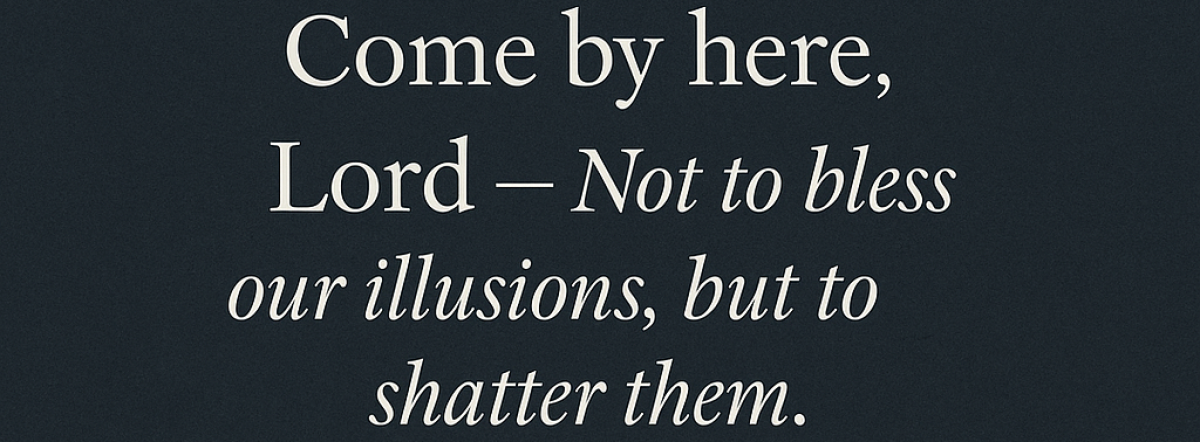
Come by here, Lord — not to bless our illusions, but to shatter them.
Come by here, Lord — not to affirm cheap unity, but to lead us into costly love.
Come by here until your justice rolls down like waters, and your righteousness like a mighty stream.

A Closing Prayer

Lord of justice and mercy,
Come by here.
Enter the spaces where truth has been silenced.
Enter the places where unity has been faked to protect power.
Enter our hearts and burn away our apathy.
Strip us of cheap grace and counterfeit peace.
Give us courage to repent, to repair, to restore,
and to walk in the costly love your Son demonstrated on the cross.
Let your justice roll down like waters,
and your righteousness like a mighty stream.
Amen.

Reflection Questions

1. When you hear Kumbaya, what comes to mind? How does knowing its true origin change that picture?

2. Where have you seen “cheap unity” — unity that avoids truth for the sake of comfort?

3. What might it cost you — in relationships, resources, or reputation — to pursue true biblical unity?

4. How can your faith community practice repentance, repair, and restoration in pursuit of God’s justice?

5. In your own prayers, what would it mean to truly invite God to “come by here”?

Lord, Is It Me?

There are moments in ministry that no seminary, no training, and no mentor could ever prepare you for. Moments where your deepest wrestlings are not with the congregation, the budget, or the community—but with yourself.

I’ve been in ministry for 27 years. In that time, I’ve learned how to navigate pain, cast vision, confront broken systems, and love deeply. I’ve stood when I didn’t think I could. I’ve preached when my spirit was empty. I’ve prayed when the words didn’t come easy.

But this season? This one is different.

This one is forcing me to ask a dangerous, sacred question:
“Lord, is it me?”

Not out of guilt.
Not out of failure.
But out of faith.

“But when evening came, he was reclining at the table with the Twelve. And while they were eating, he said, ‘Truly I tell you, one of you will betray me.’ They were very sad and began to say to him one after the other, ‘Surely you don’t mean me, Lord?’”
—Matthew 26:20–22 (NIV)

That moment around the table with Jesus resonates more now than ever. The disciples didn’t posture or pretend. They paused and examined themselves. And I find myself there too. Not because I’m betraying Christ. But because I love Him enough to wonder if, somehow, I’m getting in the way of what He wants to do through me.

I look around and see churches swelling in size, ministries going viral, and platforms growing with every click. But too often, what lies beneath that growth is theology that entertains instead of transforms, that appeases instead of convicts.

And here I am—trying to be faithful.
Preaching what I believe God has assigned to my heart.
Teaching what has been revealed through prayer, study, and sacred discernment.
Serving the community and building the Kingdom the best I know how.

Yet, growth feels slow. Sometimes stagnant.
And in moments of vulnerability, I wonder if the common denominator… is me.

What if I’m the bottleneck?
What if what I’m offering is no longer suited for a traditional church setting?
What if I’ve missed the mark?

And still—deep within—I believe I’m doing what God has called me to do.

But belief doesn’t always silence the burden.
Faith doesn’t always make the fog disappear.

So let me be honest. Let me be human.
I don’t need answers today. But I do need space.
And if you’re reading this—maybe you do too.

If you’ve ever found yourself questioning your impact,
If you’ve ever measured faithfulness by visible fruit and came up short,
If you’ve ever wondered whether your obedience really matters,
Then… come sit with me in this space.

“Let us examine our ways and test them, and let us return to the Lord.”
—Lamentations 3:40

“Search me, O God, and know my heart! Try me and know my thoughts! And see if there be any grievous way in me, and lead me in the way everlasting.”
—Psalm 139:23–24 (ESV)

I don’t want what people call success.
I don’t want vanity metrics.
I don’t want smoke and mirrors.

I just want to be faithful.
To give God my best.
To fulfill the totality of what I was created to do.

And maybe—just maybe—faithfulness means going back to the drawing board.
Not because I’ve failed.
But because I’m still being formed.

There’s no shame in reevaluation.
There’s no guilt in asking hard questions.
There’s only grace—grace to grow, to stretch, to evolve.

I don’t have all the answers.
But I still have the hunger to hear one thing from my Savior:

“Well done, good and faithful servant… Enter into the joy of your Lord.”
—Matthew 25:23 (NKJV)

Until then, I’ll keep showing up—
Searching.
Serving.
And staying close to the One who called me in the first place.


A Prayer for the One Who’s Wrestling

God of the table and the wilderness,
You who called us before we called You—
We are here with questions,
not because we doubt Your power,
but because we desire Your presence in the places we feel most unsure.

If we are the problem, reveal it.
If we are the planting, root us.
If we are the pruning, keep us.
If we are the remnant, strengthen us.

Speak to the quiet parts of our hearts.
Let our mission be Your mission.
And let us be faithful—not to outcomes, but to obedience.

May our “Well done” come not from the crowd,
but from Christ.

Amen.

I Had to Go to Prison to Be Released

Some Sundays move differently.

Usually, a visit to Richland Correctional is a fairly easy drive to Mansfield, Ohio. I’ve made the trip before—most times with a group of brothers who serve alongside me in this calling. But this time, every one of them was home for various reasons. Life happens. No harm, no foul.

Still, something felt different.

I left Columbus behind schedule. No big deal—I’ve made up time on I-71 before. But this trip became a maze of detours and disruptions. From I-70 W to I-71 N, rerouted to I-670 W, then to Rt. 315 N, onto I-270 E, and finally back to I-71 N—just to escape the metro area. Add in the fact that every driver on the road seemed to have forgotten basic traffic rules, and I found myself balancing between faith and full-blown frustration.

I wasn’t just battling traffic. I was wrestling with something deeper.

For weeks, I had been questioning whether the Lord was still on my side. Whether His presence was still walking with me. Whether He still heard me. And while I just wanted to fulfill my commitment at the prison, I didn’t realize that Richland wasn’t just another assignment—it was my altar.

Because what I thought was a delay turned out to be divine.

I arrived to witness a baptismal service for 11 men who had surrendered their lives to Christ. I stood among nearly 200 incarcerated brothers, hands lifted, voices raised, tears falling, faith rising. And somewhere between their praise and my prayer, I felt something in me break open. Something long bound up finally set free.

This Black man had to go to prison to be released.

And in that sacred space—the religious center of a correctional institution—I understood Paul and Silas a little better. “About midnight Paul and Silas were praying and singing hymns to God, and the prisoners were listening to them. Suddenly, there was such a violent earthquake that the foundations of the prison were shaken” (Acts 16:25–26). That night in Philippi, their praise unlocked something in the spirit before it ever opened the physical doors. That’s what I experienced—chains breaking, not just in the men I came to serve, but in me.

Authentic worship doesn’t wait for ideal circumstances. It breaks chains. It rattles foundations. It transforms prison walls into places of purpose.

I wish I could show you what I saw. I wish there was video evidence of how the Spirit of God filled that place. But some moments are too holy to capture—too weighty for social media. So, let me try to paint the picture:

Imagine nearly 200 men worshiping under the leadership of a Black woman chaplain who has faithfully discipled them. Imagine that atmosphere being set not for performance but for presence—not for a program but for power. And now imagine God—the Eternal Monarch—showing up in glory that knows no demographic, no background, no barrier.

Maybe the problem is we’ve spent too much time deciding who we think needs to be set free.

Jesus declared: “The Spirit of the Lord is upon Me, because He has anointed Me to proclaim good news to the poor… to proclaim liberty to the captives… to set at liberty those who are oppressed” (Luke 4:18). And He didn’t say this was only for those on the outside of bars—but for any soul imprisoned by fear, shame, doubt, trauma, or the system.

Maybe if we truly believed the words of Jesus—“Whom the Son sets free is free indeed” (John 8:36)—we’d stop putting limits on liberation.

This visit reminded me that God is still in the business of deliverance. And sometimes, to receive what you need, you have to go to the places others avoid.

Because freedom doesn’t always come with open doors. Sometimes, it shows up behind bars.


Scriptures to Reflect On:

  • Acts 16:25–26 – Paul and Silas’ midnight worship and prison shaking breakthrough
  • John 8:36 – “So if the Son sets you free, you will be free indeed.”
  • Luke 4:18 – Jesus’ mission to set the oppressed free
  • Psalm 34:18 – “The Lord is near to the brokenhearted and saves the crushed in spirit.”
  • Hebrews 13:3 – “Remember those who are in prison, as though in prison with them…”
  • Isaiah 61:1 – “He has sent Me to bind up the brokenhearted, to proclaim liberty to the captives…”

Closing Prayer:

God of Liberation and Love,
Thank You for meeting us in the most unexpected places.
Thank You for using those we overlook to show us the depth of Your grace.
Help us to see freedom not as a location but as a transformation.
May we never forget that You can move behind bars, within hearts, and beyond our expectations.
Break every chain in us, Lord. Release what’s bound. And let us walk in the freedom only You can give.
In Jesus’ name, Amen.