
Most people hear Kumbaya and picture a campfire singalong — a circle of smiling faces swaying under the stars. But that image is a distortion, a sanitized version stripped of the depth, urgency, and history that birthed the word.
Kumbaya comes from the Gullah Geechee people — descendants of enslaved Africans living along the coastal islands and low country of South Carolina, Georgia, and northern Florida. In the Gullah language, a Creole shaped by both West African tongues and English, Kum ba yah means Come by here. This was no casual lyric; it was an invocation. In praise houses and hush harbors, people would sing: “Someone’s crying, Lord, come by here. Someone’s praying, Lord, come by here. Someone’s dying, Lord, come by here.”
It was a theology of survival. Like the psalmist who prayed, “O LORD, you hear the desire of the afflicted; you will strengthen their heart; you will incline your ear to do justice to the fatherless and the oppressed” (Psalm 10:17–18), the Gullah Geechee trusted that God’s presence meant more than comfort — it meant justice. In the midst of brutal systems designed to break them, they cried out with the same confidence as Israel in Egypt: “I have surely seen the affliction of my people… I have come down to deliver them” (Exodus 3:7–8). God’s “coming down” was not abstract sentiment; it was liberation in motion.
Yet today, I am often approached by well-meaning people who speak of unity as if it were a warm feeling — a “cosmic euphoric moment” that can be reached simply by gathering together. They imagine oneness without truth-telling, without repentance, without repair. It’s the same illusion Amos confronted when he warned Israel that worship without justice is an offense to God: “Let justice roll down like waters, and righteousness like an ever-flowing stream” (Amos 5:24). That image is not a gentle trickle — it’s a relentless flood that sweeps away oppression.
Dietrich Bonhoeffer called empty religion “cheap grace” — grace without repentance, discipleship, or the cross. What I see in many unity conversations is its twin disease: cheap unity — unity without justice, without sacrifice, without dismantling the systems that harm the vulnerable. Paul’s charge to “make every effort to keep the unity of the Spirit through the bond of peace” (Ephesians 4:3) is not a suggestion to keep things calm. The Greek phrase for “make every effort” (spoudazontes) speaks of urgency, discipline, and cost. True unity is forged in the hard work of confession, reconciliation, and shared sacrifice.
As a Black man, a leader, and a pastor, I cannot and will not accept unity that demands my silence for someone else’s comfort. Too often, “peace” is defined as the absence of tension rather than the presence of justice. But Jesus Himself said, “Do not think that I came to bring peace on earth; I did not come to bring peace, but a sword” (Matthew 10:34). That sword is the dividing line of truth — the confrontation that must happen before reconciliation can take root.
If unity means ignoring the cries of the oppressed, it is no unity at all — it is collusion.
If “togetherness” means the powerful remain untouched while the wounded remain unhealed, it is not gospel — it is heresy in the name of harmony.
If “reconciliation” does not include reparations, restoration, and restructuring unjust systems, then it is simply the status quo in Sunday clothes.
The Gullah Geechee cry of Kumbaya was never a plea for cheap togetherness. It was a desperate, holy demand for the God of justice to enter their reality, meet them in their pain, and change their condition. And it is still the prayer of many Black believers today:
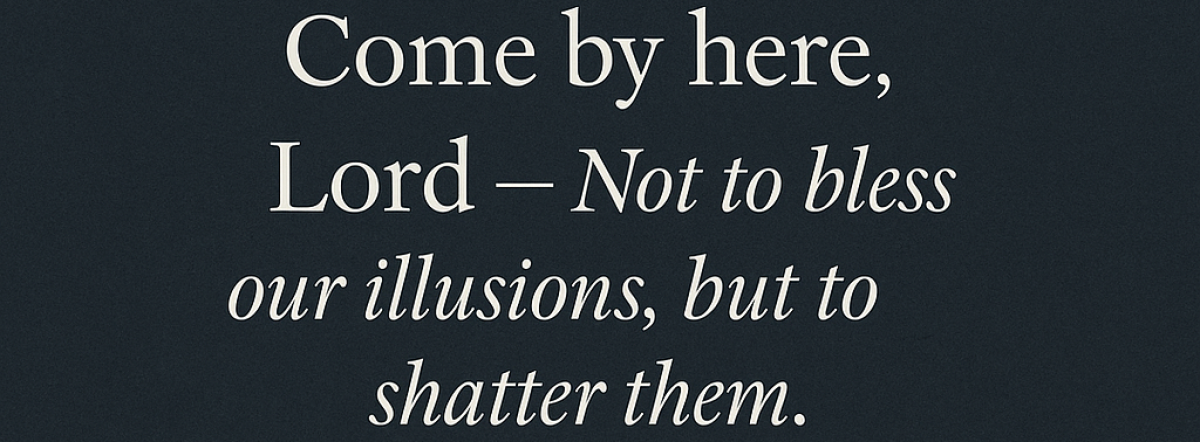
Come by here, Lord — not to bless our illusions, but to shatter them.
Come by here, Lord — not to affirm cheap unity, but to lead us into costly love.
Come by here until your justice rolls down like waters, and your righteousness like a mighty stream.
A Closing Prayer
Lord of justice and mercy,
Come by here.
Enter the spaces where truth has been silenced.
Enter the places where unity has been faked to protect power.
Enter our hearts and burn away our apathy.
Strip us of cheap grace and counterfeit peace.
Give us courage to repent, to repair, to restore,
and to walk in the costly love your Son demonstrated on the cross.
Let your justice roll down like waters,
and your righteousness like a mighty stream.
Amen.
Reflection Questions
1. When you hear Kumbaya, what comes to mind? How does knowing its true origin change that picture?
2. Where have you seen “cheap unity” — unity that avoids truth for the sake of comfort?
3. What might it cost you — in relationships, resources, or reputation — to pursue true biblical unity?
4. How can your faith community practice repentance, repair, and restoration in pursuit of God’s justice?
5. In your own prayers, what would it mean to truly invite God to “come by here”?

 Dr. Charles W. Ferguson