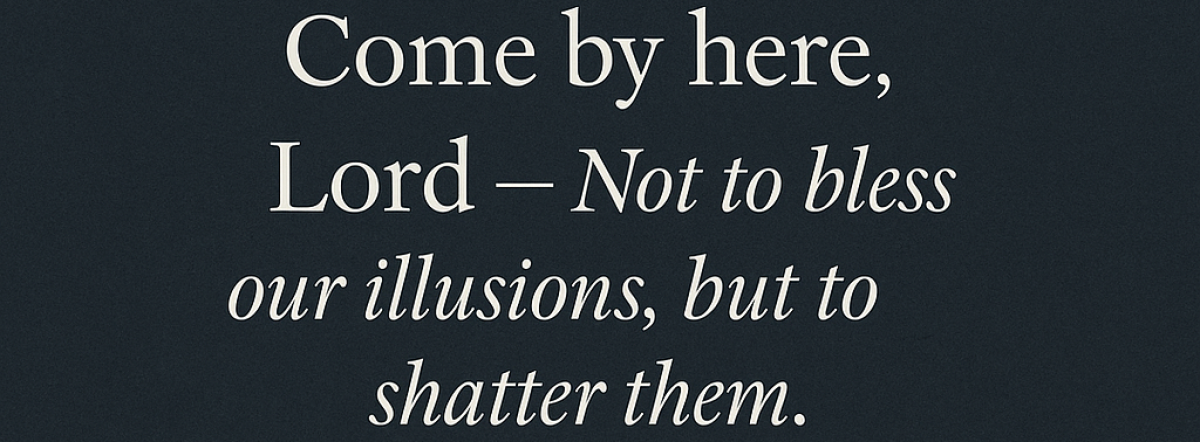
A Reflection on Frederick Douglass, Washington, and the Unconsidered Christ
On this side of Independence Day, I find myself haunted by the words of Frederick Douglass. In 1852, he stood before a crowd and asked pointedly, “What, to the American slave, is your Fourth of July?” His answer was sharp and unsparing:
“…a day that reveals to him, more than all other days in the year, the gross injustice and cruelty to which he is the constant victim.”
Today, nearly two centuries later, we are still forced to wrestle with the same hypocrisy. Recent events in Washington have laid bare the moral contradictions that Douglass decried. Laws debated and policies passed in grand chambers seem to disregard the very people Christ prioritized — the poor, the foreigner, the outcast, the Black and brown bodies that built this nation with blood and sweat and tears.
Where was Christ in these deliberations? His name was not called. His heart was not sought. His cross was not lifted. Instead, we witnessed once more the American penchant for political theater that secures power but forsakes the least of these.
The poor were rejected.
Budgets were balanced on their backs. Relief delayed, assistance cut, while billionaires celebrated new tax loopholes.
The foreigner was vilified.
Families fleeing violence were met with barbed wire and bureaucratic cruelty.
Black people were told to wait — again.
Wait for justice, wait for dignity, wait for their full humanity to be recognized. As if we have not waited long enough.
And so Douglass’s words echo with fresh relevance, indicting a nation that preaches liberty while practicing exclusion, that celebrates freedom while perpetuating systems that choke the very breath from the oppressed.
The Testimony of Scripture
The Word of God stands in holy opposition to the machinery of colonialism, imperialism, and greed. Consider these words:
“Do not oppress the foreigner; you yourselves know how it feels to be foreigners, because you were foreigners in Egypt.”
(Exodus 23:9)
“Woe to those who make unjust laws, to those who issue oppressive decrees, to deprive the poor of their rights and withhold justice from the oppressed of my people.”
(Isaiah 10:1-2)
“He has filled the hungry with good things, but has sent the rich away empty.”
(Luke 1:53)
These are not passive suggestions — they are divine demands. God’s law was always bent toward protecting the vulnerable, always suspicious of empire. Jesus was born under occupation, executed by an imperial power, and rose to declare a kingdom not of this world.
My Rejection of Colonialism and Imperialism
As a disciple of Jesus Christ, I reject the colonial imagination that built this nation on stolen land and enslaved labor. I reject the imperial impulse that sends drones instead of diplomats, that sees military might as salvation. I reject a Christianity co-opted by nationalism, that wraps the cross in a flag and dares to call it holy.
Instead, I stand with the Christ who flipped tables, who touched lepers, who broke bread with traitors and sinners. I stand with the Christ who said:
“The Spirit of the Lord is upon me, because he has anointed me to proclaim good news to the poor… to set the oppressed free.”
(Luke 4:18)
So What is the Fourth of July to Me?
It is a reminder that the work is unfinished. That fireworks crackle over graves of enslaved ancestors. That freedom is still unequally distributed. That God’s call to “let justice roll on like a river” (Amos 5:24) is still unheeded by many in power.
But it is also a reminder of hope. Because every Douglass rises again in new generations — truth-tellers, justice-seekers, peacemakers who refuse to bow to empire. And the same Spirit that stirred Douglass still moves, unsettling our comfort, compelling us toward a more faithful, more liberating witness.
May we listen. May we rise. May we refuse to celebrate a freedom that is not truly for all. And may we live in such a way that Christ is not merely an afterthought in our politics, but the very cornerstone of our public life.
A Prayer for This Nation and for the Oppressed
Gracious and righteous God,
We come before you heavy with the weight of injustice,
yet hopeful because we know you hear the cries of the oppressed.
You are the God who sees —
who saw Hagar weeping in the wilderness,
who heard the blood of Abel crying from the ground,
who stood with the Hebrew slaves against Pharaoh’s empire.
See us now, O God.
Hear the anguish of the poor, the foreigner, the Black and brown bodies
still bearing the scars of systemic violence.
Break our hearts for what breaks yours.
Forgive us for our complacency,
for the ways we have benefited from systems of power
that crush your children.
Cleanse us from the lies of nationalism that confuse the flag with the cross.
Rise up within us a holy anger against injustice
and a holy love that refuses to let hatred win.
Make us instruments of your peace,
warriors for your justice,
and sowers of your reconciling love.
May your kingdom come —
not as empire, not as colonial conquest,
but as liberating good news to the poor,
sight for the blind, freedom for the captive.
Let justice roll down like waters, O God,
and righteousness like an ever-flowing stream.
And let it begin in us.
In the name of Jesus, who stood with the oppressed
and conquered the powers of this world by love,
we pray. Amen.

 Dr. Charles W. Ferguson